Your First Ice Hockey Match: Follow the Changes at the Bench
Learn how to follow player changes at your first ice hockey match, spot line changes and understand why teams substitute during live play.
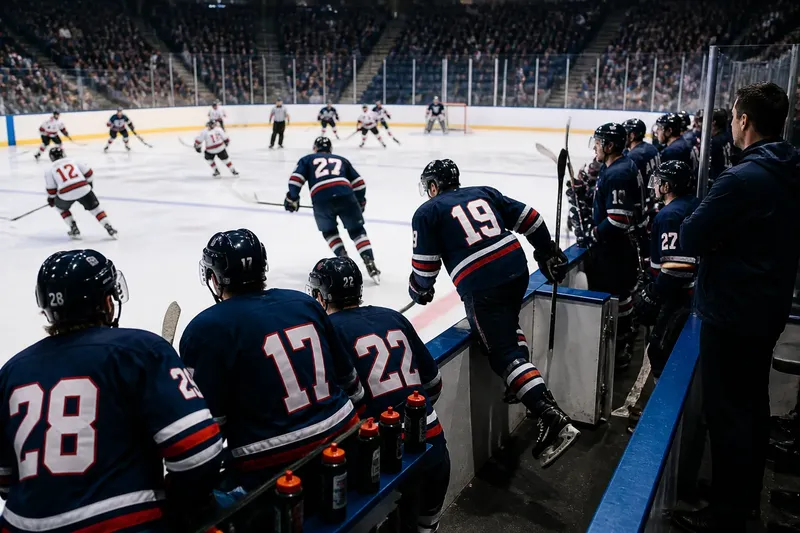
At your first ice hockey match, the puck may disappear behind a crowd of skates just as the play gets interesting. Player changes are often easier to follow. Watching them helps you see how teams rotate fresh players while the game continues.
At an ice hockey match, a shift is a player’s spell on the ice before being replaced. Substitutions can happen while play is live, so there is no formal pause for every change. Follow the pattern rather than trying to count each pass or memorise every player.
Find the benches
Look for the team benches before settling into the action. They are commonly along the boards, often near the neutral zone, but placement can vary by rink and competition. Check the venue map or arena layout if you cannot locate them from your seat. Players waiting there are ready to enter; players leaving the ice head towards a bench door.
Notice that players often operate in groups. Forwards usually form a line of three, while defencemen commonly work in pairs. Coaches may alter those groups, and players can change individually, so treat the pattern as a guide rather than a fixed cast list.
Choose one team to watch first. Follow a forward line or defensive pair, using jersey numbers or familiar kit details to recognise players. A programme or roster can help match names to numbers, but there is no need to account for every helmet.
Read the first changes
When play starts, watch your chosen group leave the bench and take up positions. A forward line spreads across the rink; defencemen generally play behind the forwards, nearer their own goal. The shape changes as play moves, but a group entering together is a useful first clue.
For a change, one player may skate towards the bench as a teammate enters over the boards or through an open door. The outgoing player must be close to the bench before the replacement joins play; otherwise, the team risks having too many players on the ice. Officials may penalise an illegal substitution.
Changes often happen while the puck is moving elsewhere. A player may leave after moving the puck out of danger as a teammate enters and heads towards the developing play. The change is part of the action, not a break from it.
For your first few shifts, watch only the chosen group. Ask who is leaving and who is taking that player’s place. If you lose track, look back to the bench for the next recognisable group.
Use stoppages
At a face-off, players gather around the spot where the official will drop the puck. The pause can make it easier to see who is on the ice and who is waiting to replace them. After a whistle, substitutions may be made before the next face-off, subject to officials’ procedures.
Do not assume the same five skaters take every restart. Coaches may choose players for the situation, and the line on the ice can change after a stoppage.
Penalties alter the usual pattern. A team whose player is serving a penalty may have fewer skaters on the ice, while its opponents have a power play. Watch which players the benches prepare for the next shift rather than expecting the usual lines to appear unchanged.
Say you are watching the home team and lose sight of its left winger during a scramble. At the next whistle, you see a different winger beside the centre at the face-off, then spot the earlier player waiting at the bench. You can infer that a change took place without knowing who carried the puck or how the scramble began.
Compare change patterns
Once the basic pattern feels familiar, compare how the two teams substitute. One may send a full forward line over the boards together; another may make a partial change, with one player replacing a teammate. Defensive pairs can change in a similar way. Variation is normal.
Pay attention to timing, not speed alone. A tired player may head off at the first opportunity, while a teammate enters to support the play. Changing can be riskier when the puck is near a team’s own goal, because a replacement could join before the outgoing player is safely off. A team may wait for a better moment.
When several players prepare to leave together, a line change may be coming. When only one moves, it may be an individual substitution or a response to the situation. You need not identify the reason each time; note what you can see.
There is no need to time shifts with a watch. Their length varies with the flow of play. Notice whether a team can change and whether its next group reaches the action in good order.
Questions about changes?
Can players change while the puck is live?
Yes. Ice hockey allows substitutions during play, provided the players change legally and the outgoing player is close to the bench before the replacement joins in. The change keeps play moving, but it is not a leisurely exchange.
How many players are in a line?
A forward line usually consists of three players, while a defensive pairing consists of two. Teams can rearrange these groups or substitute fewer than a full group when circumstances call for it.
Why do players change so often?
Hard skating takes effort, so teams replace players to bring fresh legs onto the ice. Coaches may also choose players for a particular situation, such as defending after a face-off or playing with a man advantage.
What changes after a penalty?
A penalised player may have to sit out for the penalty’s duration, leaving their team short-handed. The opponents then have a power play, and both teams may adjust which players take the next shifts.
Watch late decisions
Keep the same focus in the final period, then compare changes when a team is attacking and defending. A forward line may pursue the puck while a defensive pair stays positioned to protect its own end. The bench can show which players are being sent into those situations.
Late in a close match, a team may take its goalkeeper off for an extra skater. This is a deliberate tactical choice: the team gains another attacker but leaves its goal unguarded. If the goalkeeper heads to the bench, look for the extra skater entering the rink.
To follow player changes at an ice hockey match, keep track of who is on the ice, who is waiting and what has changed since the last whistle. If a substitution or call remains unclear, check the arena display or ask a knowledgeable companion during a stoppage.