The One-Position Player Myth: How Roles Change During a Match
The one-position player myth misses how football roles change by phase. Learn to read a player’s changing duties as possession shifts, without losing sight of their starting position.
Why does a full-back sometimes appear in midfield, while a winger tracks an opponent deep into their own half? The one-position player myth treats a team sheet as a map of fixed jobs. In football, a position describes a starting area; a role describes what a player is asked to do at a particular moment.
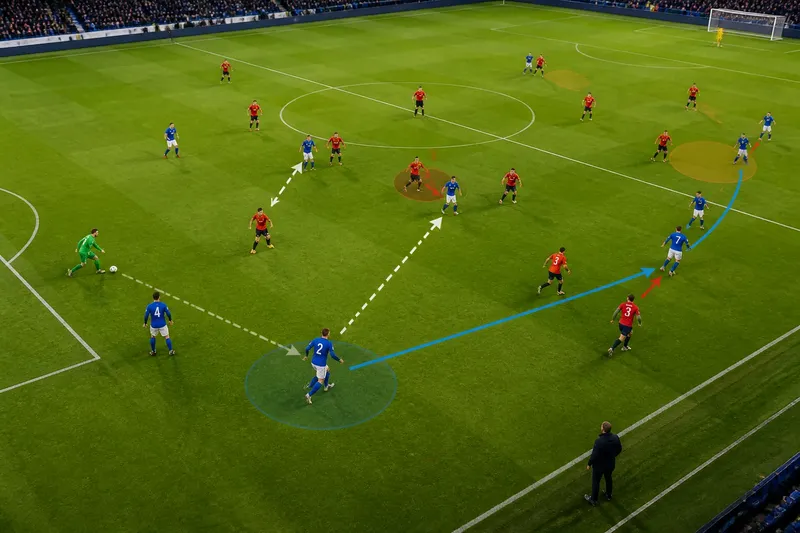
Imagine a hypothetical side trying to play out from the back against opponents who press high. Its right-back begins near the touchline, but the team’s plan changes as the ball moves. The player’s address stays the same on the team sheet. The work does not.
The starting picture
The imagined team lines up in a familiar shape, with four defenders, a midfield and forwards. The right-back starts wide of the centre-backs. The right winger waits further forward on the same flank. Those positions give the players a reference point, not a promise that they will remain there.
The opponent sends a forward towards the right centre-back and blocks the easy pass into central midfield. The right-back now has a choice shaped by the team’s needs. If they remain wide, they offer a route along the touchline. If they move infield, they may become a short central option and help the team keep the ball.
The coach’s instructions matter, as do the players’ skills and the opponent’s arrangement. There is no universal rule that a full-back must move inside, or that every team should build in the same way. The useful question is what problem the movement is meant to solve.
Possession changes the job
In this imagined passage, the right-back steps into a central lane as the goalkeeper passes to the centre-back. The right winger stays wide. That leaves the opponent with a choice: follow the right-back into the middle and open space outside, or hold position and allow a spare player to receive centrally.
The right-back has not become a midfielder in every sense. They may be expected to offer a passing angle, help protect against a counter-attack and move back towards the flank if the ball goes there. The role is a bundle of tasks, not a new label stamped on the player.
The ball reaches the right winger, who turns towards the opponent’s goal. The right-back now moves forward on the outside, offering an overlap. In a different moment, the same player could stay behind the ball to keep the defence secure. The winger’s movement, the location of the ball and the opponents’ positions all affect which task makes sense.
Watch the spaces a player creates as well as the touches they take. A run that draws a marker away can help a teammate even if it never receives a pass.
The turnover test
The imagined attack ends when the winger’s pass is intercepted. This is where the right-back’s role changes again. They are high and wide, so they cannot simply resume their starting position at once. Their first task may be to slow the counter-attack, while a nearby midfielder covers the space behind them.
That temporary exchange is part of team defending. One player presses the ball; another blocks a forward pass; a third protects the space the first two have left. The players are not necessarily swapping positions for the rest of the match. They are sharing duties until the team can recover its shape.
Suppose the opponent turns back rather than attacking quickly. The right-back can then retreat towards the defensive line, while the midfielder returns to the centre. If the opponent instead sends a runner into the channel, the right-back may need to track that runner and leave the central area to a teammate. The immediate danger sets the priority.
When possession changes, look first for who can delay the attack and who covers the space behind. The original positions can wait until the team is safe.
Shape without the ball
The opponent keeps possession in the invented sequence. The right winger drops back, and the right-back takes a position behind them. The team now defends in two lines. The winger’s job includes helping protect the flank; the right-back’s includes watching the space behind and being ready to challenge a pass down the line.
These duties can change again when the ball moves across the pitch. The right-back may narrow towards the centre to help guard the goal, while the far-side defender holds a position that covers a possible switch of play. A player’s defensive role depends partly on where the ball is, not only on which side of the formation they began on.
In this case, the opponent tries a pass into the right channel. The winger slows the receiver, giving the right-back time to come across. A central midfielder fills the space the defender has left. The team’s shape bends around the ball, then settles when the danger passes.
How do roles change?
Is a position the same as a role?
No. Position usually describes a player’s broad starting area, such as right-back or centre-forward. Role refers to the tasks they perform in a particular phase, such as supporting build-up, stretching the defence or protecting a channel.
Why does a full-back move into midfield?
A team may use that movement to offer a passing option, draw an opponent out of position or add cover behind an attack. It is a tactical choice, not a requirement for every full-back or every system.
Can a player have several roles in one match?
Yes. A player can support the attack, recover into a defensive line and then press after a turnover, with different responsibilities in each phase. The change can happen without any substitution or change to the team sheet.
How can I tell what a player is doing?
Look at the ball, the nearest opponents and the spaces teammates leave behind. Then watch whether the player is offering a pass, drawing a marker, closing an opponent or covering a teammate.
The sequence resolves
The opponent’s channel pass is contained, and the ball runs out for a throw-in. The right-back has occupied several different roles during one continuous passage: a central outlet during build-up, an overlapping option in attack, a defender against the counter and a cover player without the ball. None cancels out the original position.
For a spectator, the team sheet is still useful. It tells you where players are likely to begin and gives you names for their usual areas. But a position is a poor substitute for watching what the team asks a player to do as possession changes hands.
The one-position player myth makes tactical movement look like an exception. In practice, the team’s needs can change from one phase to the next, and roles change with them. To read a player well, follow the job they are doing now, then notice what changes when the ball moves.
Next time a defender appears in midfield, ask what space that movement opens or protects. The answer is usually more revealing than the label on the team sheet.