Why a Basketball Screen Forces a Split-Second Choice
A basketball screen changes the defender’s route and gives two attackers a choice. Learn to read the pick-and-roll through the space it creates.
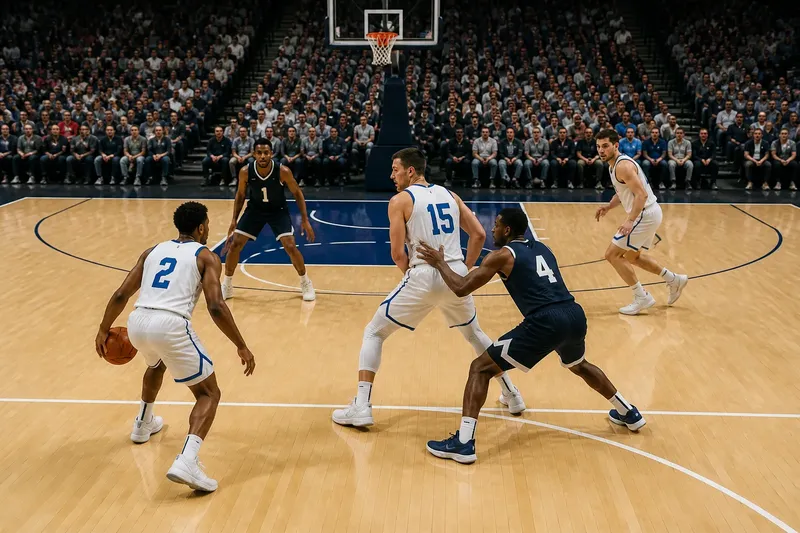
Why does a basketball screen make a defender hesitate even when the ball-handler has not yet moved? A screen changes the route the defender can take, and that moment of uncertainty gives two attackers a choice. The pick-and-roll is easiest to read as a change in available space, not as a coded play with one correct ending.
Reading the screen
One attacker controls the ball while a teammate plants a legal screen in the defender’s path. The ball-handler can turn around the screener; the screener can then move towards the basket. That second movement is the roll. The defence now has to account for both the ball and the player moving away from the screen.
Watch the defender guarding the ball first. Before the screen arrives, that player can track the ball-handler directly. Once the screener blocks the most direct route, the defender must go around, under, or through the gap between the attackers. Each route gives the ball-handler a different amount of room and leaves another defender with a different problem.
The screen itself is not a collision licence. The screener must establish a legal position and cannot simply step into a moving opponent. For a spectator, the useful distinction is practical: a defender slowed by a properly set screen has to recover, while a defender met by an illegal moving screen may be awarded a foul.
When the defender trails
A common difficulty is spotting why the ball-handler suddenly has a lane. It often happens because the defender goes over the screen but cannot catch up at once. The attacker has turned towards the basket, while the original defender is behind or alongside them.
The ball-handler can use that brief lead to drive, stop for a shot, or draw a second defender. The right choice depends on the space ahead. If another defender steps across to help, the roll man may be free. If nobody helps, the ball-handler may have a clear route of their own.
Say a guard dribbles towards a screen near the top of the key, and the defender follows over it but falls behind. If the defender guarding the screener stays near the basket, the guard may drive into the gap; if that defender steps out, a pass to the rolling teammate may be available. Watch which defender moves first, then look at the space that movement leaves.
When the defence drops
Sometimes the defender guarding the screener stays back near the basket instead of coming out to meet the ball-handler. This is often called dropping or playing drop coverage. It protects the route to the rim, but it can leave the ball-handler room to shoot from farther away or pause for a mid-range shot.
The common spectator’s mistake is to assume the screen has failed because nobody has been beaten outright. In fact, the defence may have traded a direct drive for a shot from a less dangerous area. The ball-handler still has to decide whether that space is worth using, while the screener may continue towards the basket in case the defenders turn their attention to the ball.
To read the exchange, check the defender nearest the basket. If that player remains deep, note the shot or passing lane the ball-handler has gained. If the defender advances, check whether the rolling teammate is now behind them. The result is not always a shot or a pass; sometimes the attackers simply force the defence to move and then continue the possession.
When both defenders switch
A switch means the defenders exchange assignments: the screener’s defender takes the ball-handler, and the original ball defender covers the screener. It removes the immediate chase around the screen, but it can leave each defender matched with a different type of attacker.
That mismatch is an opportunity, not an automatic advantage. A taller defender may stay in front of a smaller ball-handler, or a quicker defender may keep pace with the screener. The attackers can try to use the new pairing, but they still need enough room and time to do so. If the defence communicates early and keeps the ball away from the basket, the switch may have done its job.
Look for the moment after the screen, not just the screen itself. If the original defender is now guarding the roller, the assignment has changed. Then ask whether the ball-handler attacks that defender, passes to the roller, or keeps the ball while the defence settles.
When the pass disappears
A rolling teammate can look open to a viewer while the pass remains difficult. The ball-handler may be crowded, the lane may be narrow, or a third defender may already be positioned between the ball and the basket. The roll creates a possible route; it does not make the route safe or available by itself.
When the pass is blocked, watch the ball-handler’s next decision. They may keep dribbling, pass to an attacker on the perimeter, or retreat from the congested area. A possession can still benefit from the screen if the defence has been pulled towards the ball and another attacker is left with room.
Do not judge the choice only by whether the roller receives the ball. The defender’s movement is part of the action. If a help defender leaves a shooter to cover the roll, the ball-handler may pass out to that shooter instead. The screen has then changed the defence’s shape, even though the ball never reaches the screener.
What should you watch?
Where should I look first?
Start with the defender guarding the ball. Note whether they go over, under, or around the screen, then check how quickly they return to the play. That first route explains much of the space the attackers gain or lose.
Why does the ball-handler pause?
A pause can let the screener’s defender reveal whether they will stay back or step out. It can also give the ball-handler a moment to see whether the roller or a perimeter teammate is free. The dribble has stopped briefly, but the decision is still active.
What does the roller want?
The roller moves towards the basket to become a passing option and occupy a defender. They may receive the ball, draw help away from another attacker, or simply make the defence account for their movement. A roll is therefore useful even when it does not end in a pass.
How can I tell whether the screen worked?
Look for a change in the defenders’ routes or assignments, rather than demanding an immediate basket. If one defender is delayed, forced to help, or made to switch, the screen has created a decision. Whether the offence uses that opening well is a separate question.
Follow the open space
For a quick read of the pick-and-roll, follow three things in order: the ball defender’s route, the screener’s defender’s position, and the space left for the roller or another attacker. That sequence makes the play legible without requiring knowledge of a team’s terminology. A basketball screen is less a command than a question posed to the defence; the most revealing moment is the answer it gives with its feet.
Next time the ball-handler reaches a screen, look away from the ball for a beat. The defender who moves to help often reveals where the next opening will be.